April 12, 2023 | Farvardin 23, 1402
Tajrish.
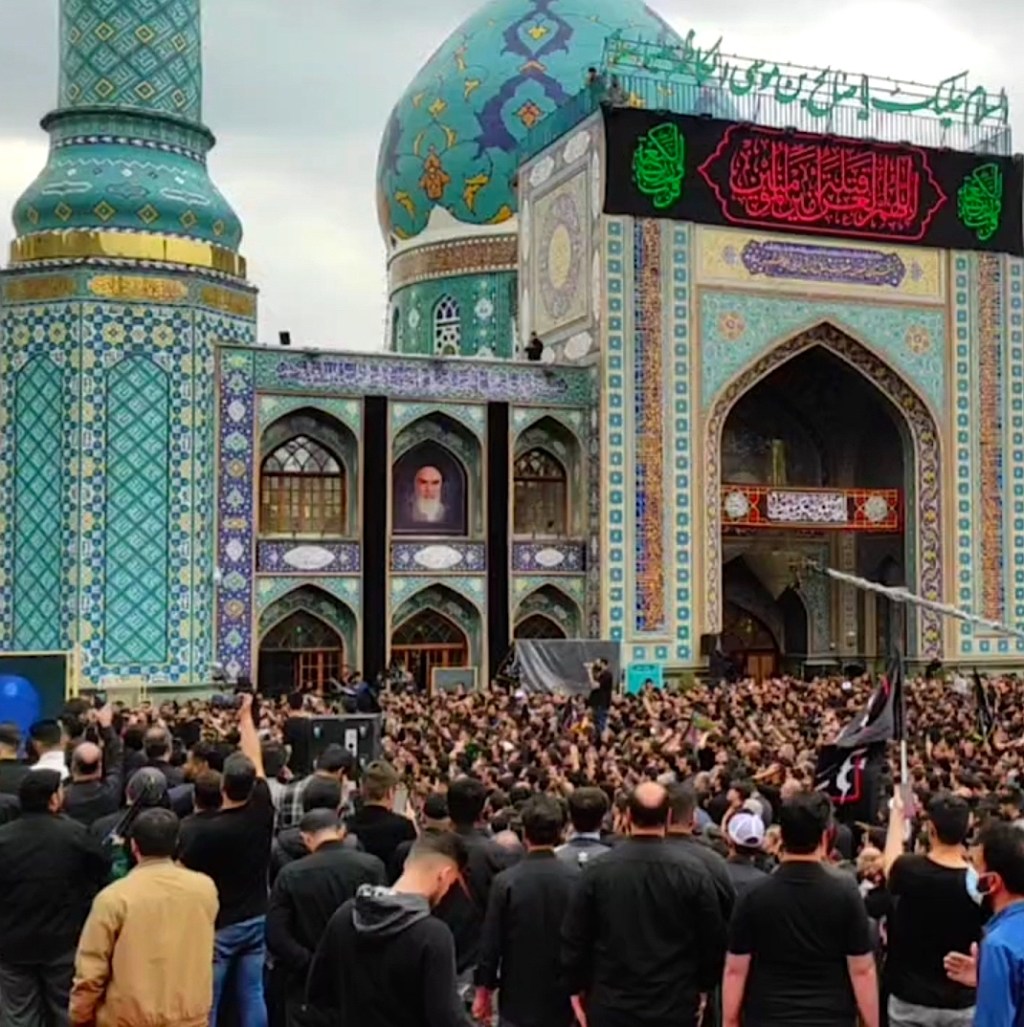
Image: Imamzadeh Saleh viewed from the Tajrish produce bazar; men gathered to commemorate Imam Ali’s martyrdom.
Understanding the Currency
I woke up at 5:40 AM. Heritage Hostel serves breakfast, but I need to wait at least 2 more hours. Took a shower in the type of washroom where the shower and the bathroom share the same floor and drain, with no barrier. I need to figure out how to use the currency, so I fixed my bed and used it as a desk. Laying out all my bills and sorting them into stacks, I clipped each stack of bills separately. On the front, I attached a sticky note that gives the approximate USD value of each stack of bills. 2,000,000 IRR (Iranian Rials) is about 4.15 USD (U.S. dollars). All around Iran, prices are listed and expressed in the informal toman short-hand. 2,000,000 IRR is represented as 200,000 toman. For larger quantities over 10 million, say 15,000,000 IRR, the conversion changes a bit; the price may be listed as 150 toman or 1,500 toman (Spoiler alert: for two months, I never got the hang of using tomans, but I did quickly get used to using IRR values.)
Ramadan and Zarb-e Imam Ali (A.S.)
Today is the 21st of Ramadan. The 21st marks the anniversary of Imam Ali ibn Abi Taleb’s assassination (martyrdom). See footnote below for more context. I knew there would probably be a commemoration at one of the mosques tonight, but I had no plans for the evening yet. I had breakfast, realised I was vastly overcharged at the hostel for my two-night booking, and my friend called another hotel so I could reserve a room for a week. We went to the bank, and then we walked to Ferdowsi metro station, where we would meet up with another one of my friends, and they would both introduce me to using the metro and show me around Tajrish.
Impressions of Tehran’s Metro Stations
We descended down each escalator, stopping at multiple levels, each with several shops for the commuters, until we reached the abyss. I was amazed by the cleanliness, efficiency, and extra utilities of the metro. Or maybe that’s just me being used to New York and D.C. I was taught how to refill my metro card with money, and how to navigate the metro to get to different points of Tehran (it’s the same system used in other countries). The train arrived on time, and we went east to Darvazeh Dowlat, switched to the red line, then went north to Tajrish. In the train, I observed countless women, elderly and young, without their headscarves. I was happy to see a mix of covered and uncovered women interacting with one another. Though I don’t wear a head scarf in my regular life, I kept it on. I have a personal rule for complying with customs when I am in a guest in a foreign place.
Fal-e Hafez
A little boy approached me with a stack of small sheets of paper, the size of an index card. My friend gave the kid a small amount of money, and took a sheet. I learned about Fal-e Hafez. It was explained to me as a tradition in Iran for fortune-telling. You open one of the random sheets given to you, which has one of Hafez’s poems inscribed within. The first line your eyes land on upon opening the paper with his poetry tells your fate in a mystic way. Up to the reader to decipher what that means.
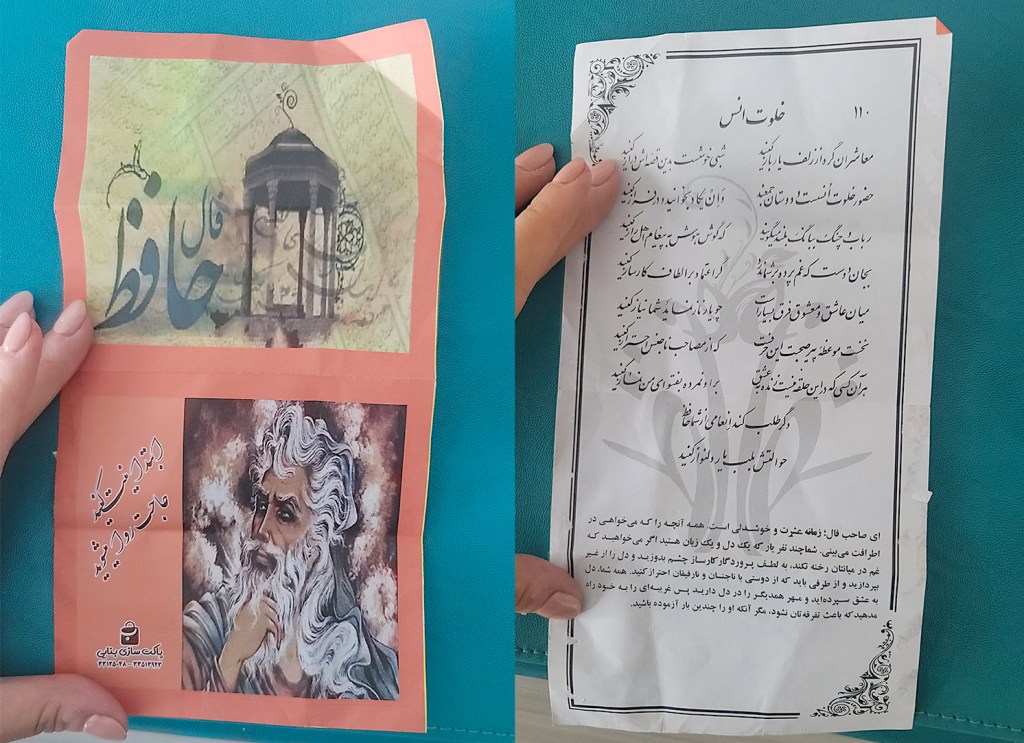
this might be about human solitude.
Tajrish
We arrived, and we ascended to the surface, and the first thing I noticed was how much colder it was in Tajrish than in central Tehran. Significantly colder! There was very light rain with sleet. Our proximity to the snow-capped mountains took my breath away. We sauntered past the shops in the street and entered a semi-open air bazaar. I studied mountains of saffron and spices, and booths with miveh torsh as I walked through, when I suddenly heard some . . . electronica beats.
We followed the rhythm, and with all the mixed sounds around me, I began to wonder why there’d be a disco during Ramadan, but regardless, I really wanted to be where the fun was. We cut through alleyways and the bustle of the bazaar faded as the electronica got louder.
As we approached the source of the sound, I realised how naïve my original thought was . . .
⟡ Heart-beats for Imam Ali ⟡
⟡
We saw an open courtyard below, next to a turquoise mosque imamzadeh (the shrine of someone descended from an Imam), with what seemed like a thousand people all tapping their chests in synchrony. The sheer volume of this movement radiated through the bazaar. The loudspeaker was responsible for the rhythm; narrator was reciting/chanting something in Persian, but I managed to pick out the name “Heidar” (an honourific; one of the many ways to say “lion” in Arabic).
Accompanying the background of his sacrilegious chants was a subtle ootz-ootz/whooshing effect that I think is supposed to sound like a heartbeat. ⟡ I tried to research this, but I don’t even know what keywords to search for and I came up with no information.⟡
All at once we became part of the pulsating rhythm of a thousand gentle heartbeats.
Over one hour later, I started to get sensory overload. All those new sounds, and especially the big crowds, became overwhelming. I was still foggy from jet-lag and the realisation that I was actually in Iran hadn’t set in yet. Time to leave.
Damnoosh: floral and herbal “tea” with spices, roots, and dried fruit.
It was almost sundown, so we walked to a tea house near Ferdowsi Garden and ordered damnoosh.
FOOTNOTE: If you’re keen on understanding the dominant faith in Iran, or just interested in theology, you need to understand the significance of Imam Ali, which is not seen in Sunni-majority countries such as Egypt, Qatar, or Jordan. He is the second most important Islamic figure in Shi’a Islam after the Prophet Mohammed, was in the midst of prostrating in prayer when he was struck on the head by a sword coated in poison by a dissident on the 19th of Ramadan in ~661 CE, and succumbed to his injuries two days later. In Sunni Islam, he is known as Caliph Ali; the fourth caliph to lead the Rashidun Caliphate. The Prophet delegated Ali as his successor in leadership, due to his loyalty, competent character, and high morale, during the gathering of Ghadir Khumm. Upon the Prophet’s death, as Ali was still preparing the body for burial, Abu Bakr al-Saddiq was proclaimed with the title of first caliph among his followers. In my experience, this is a very sensitive subject for many Shi’a’s and Sunnis, so don’t open the subject with anyone unless you’re mentally ready. Today, Imam Ali (along with his household) is regarded as an icon for Shi’a Islam, and is a symbol for Muslims in his stance against corruption and the Umayyad’s military injustice; lessons of the past that are still relevant in today’s world.

 Iran, Az Cheshmanam