
April 17, 2023 | Farvardin 28, 1402
Tehran.
Image: Ceramic tile pieces repair the broken pavements all along Ferdowsi street.
Important: scroll down if you like cats.
Crossing the Street
Today I begin my second week in Iran. All my senses are constantly heightened as I try to remain vigilant as a solo person with poor language skills. My body feels tired. Also, my body is using so much adrenaline just to complete something as simple as crossing the street. No, you don’t need language fluency to do that. You need stamina and street smarts!
Here is a new tip: Never wait at the crosswalk; you’ll look like a foreigner and you’ll wait forever, because cars don’t stop for pedestrians here. Watch for a short break, even if a car is quickly approaching, and you just start walking. Trust that all the approaching cars will manoeuvre around you or slow down, but ONLY if you’re already walking on the road. Walk whilst keeping your gaze towards oncoming traffic, and never look straight ahead as you walk. Never run! Up until now, I still run across the street like a mad woman, but my friends always tell me to keep the same brisk pace or I will confuse the drivers and they’ll miscalculate.
What should have been a 1 hour walk to the National Museum of Iran, took me a little over 2 hours, as many streets needed crossing.
Kashi Wabi-Sabi!
The long trek from Howeiyza Hotel to the museum was made longer by the following obstacles: (1) every stray cat needed acknowledgement and pets, (2) every chaotic intersection that needed crossing had to come with another brief a surge of adrenaline, lots of hesitation, and an internal screaming pep-talk to myself that “I can do it”, (3) admiring pretty mosaics. All along Ferdowsi street, where the tiles that make up the city pavement were missing or broken, pretty colourful mosaics patched up the ground. The city could have simply repaired the pavement with matching tiles, but the broken bits of unmatching kashi (ceramic)— which could have otherwise been discarded as waste—filled in those gaps to not only create something unique and beautiful, but also flexes Iran’s rich ceramic culture to all pedestrians who tread upon this street.

Mouzeh Melli Iran
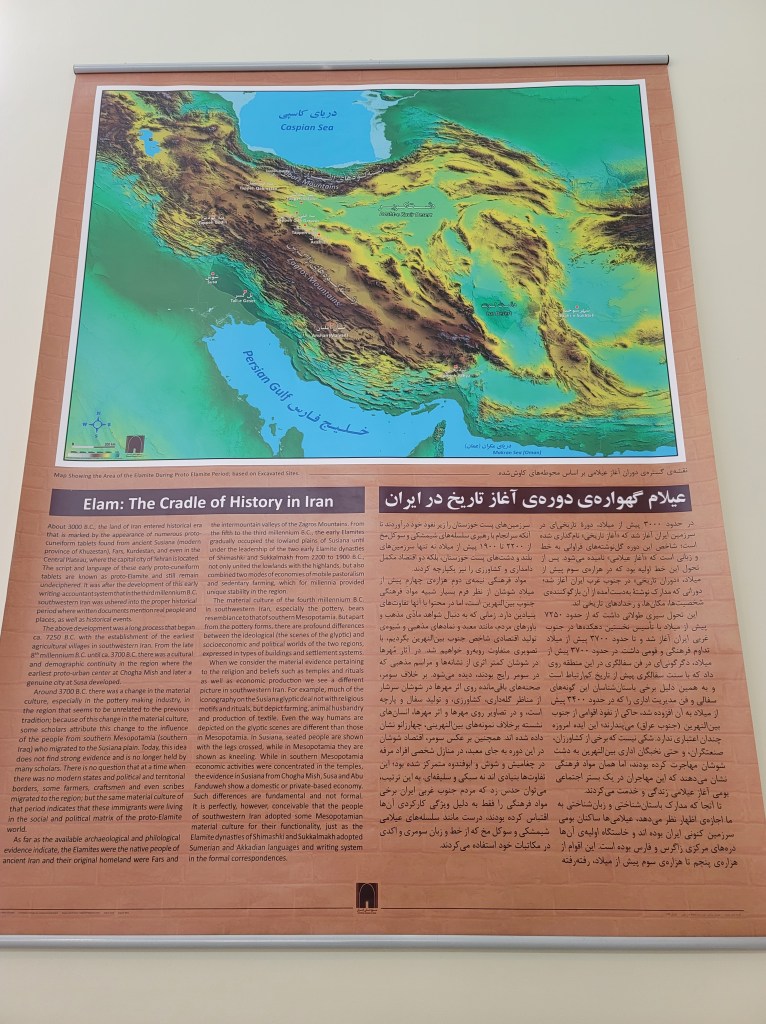
I arrived to the National Museum of Iran, but accidentally made a full circle around the building because I was looking for the entrance, and had already passed by it. I spotted a tour bus parked nearby, and many Chinese tourists eager to go inside. I went through the gate, bought my ticket, answered the usual small talk of where I come from, and saw yet another surprised reaction that I’m the first they’d seen. Whenever people find out where I’m from, it’s an extra push for me to be more mindful about being the best possible representation (whilst still being my authentic self, of course). There are two museums once you get through the gate. One building is ancient Iran, running from the Bronze Age to the Sassanid era, and another one is for post-Sassanid (post-Islamic) Iran. Both museums had a vast collection of artefacts, statues, manuscripts, cuneiform slabs, and material culture on display. There were little captions in the glass display cases, and larger signage on the walls for more historical context. However, it was not as engaging. The way of presenting history should be accessible and inviting to the general public; museums should make information processing and learning instant, so the clients do not have to exert themselves in learning with too much advanced information. In this museum (same as the museums I visited in Egypt and even in Greece), you walk through a labyrinth and are overwhelmed with information, so you kind of fend for yourself. It helped that I walked in with an understanding of ancient Near Eastern/West Asian civilisation, so whilst I still had to reorient myself with every new room I entered, I was still able to enjoy the museums, and spent several hours getting intimate with the histories.
Cats Cats Cats
Cats are amazing. I left the museum, and a white cat followed me around the courtyard. I sat on a bench and gave the cat obligatory pets. A short moment later, I noticed that it had shed white fur all over my long black manteau. A badge of honour. Now I can make it known to the public that I am a cat lover.
I walked over to Park Shahr for some quiet time. More streets needed crossing, and for some reason it took me over an hour to walk there. Khayyam street took me almost 15 minutes to cross, but to be fair, I am an amateur and it was rush hour.
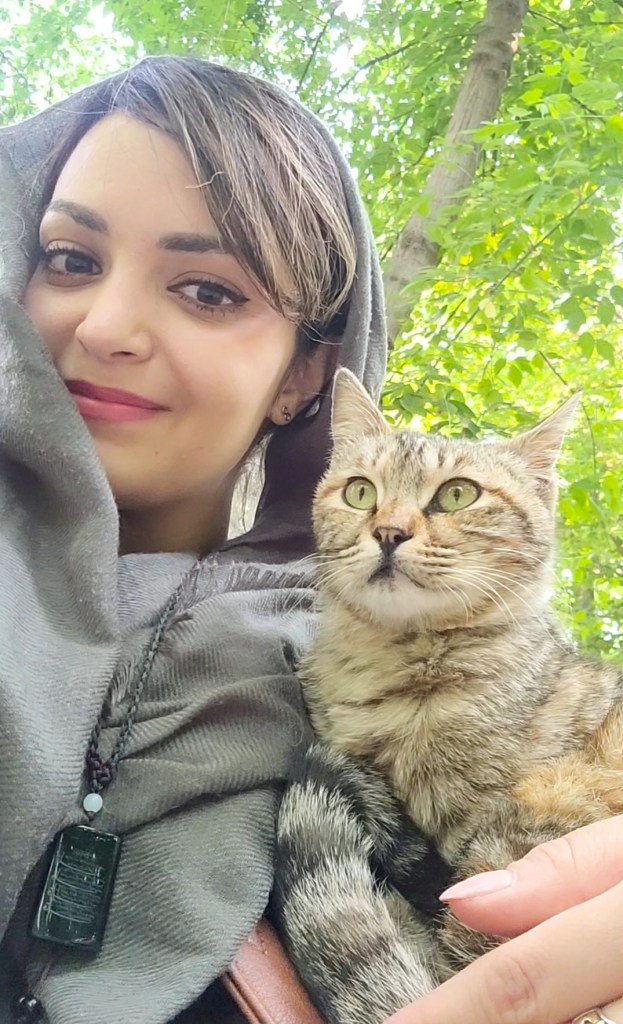
Once at the park, I could finally walk in a fast pace without worry. I later found a shaded bench and as soon as I took a seat, a friendly tabby jumped to sit by me. He made himself at home in my arms and purred. 10 minutes later, the cat fell asleep and I was stuck in an uncomfortable position for almost 1 hour. I didn’t want to wake him up from sacred slumber.
Poor little kitty. I wonder why he found tranquility in me, a complete stranger, for him to feel safe enough to fall asleep and use me as a pillow? Can I adopt him?
Bazaar of Tehran
Almost iftar time. That’s the post-sundown meal eaten after breaking the fast for the day during Ramadan. I met my friend after work near the park, and we walked 2 kilometers south to get to Tehran Bazaar. No problems crossing the street this time, as I had an experienced street crosser with me. It was significantly more crowded than Tajrish bazaar, so maybe it’s because we are in the days leading up to the Eid holiday, or just because Tehran is generally busier than Tajrish. The outside perimeter of the bazaar near the street was packed, but walking through the inside maze, it was quiet and empty. Most of the stores were closed, and many blue pickup trucks rolled by, with a tower of boxes and goods sitting in the back. I noticed many of the shop keepers in open stores with their heads down.
An hour later, we walked to a random restaurant where I tried bitter orange (narenj) squeezed over chicken kabob, and I was not expecting to love it as much as I did. In Shiraz right now, the bitter oranges are slowly taking over the city, and filling the air with its aroma.


 Iran, Az Cheshmanam