
April 20, 2023 | Farvardin 31, 1402
Hamedan.
Image: Alvand Mountains, photo taken looking west from Tepe Ecbatana Archaeological Site.
Leaving Tehran
Today I depart for Hamedan by bus. I rushed to prepare for both checking out of Howeizah Hotel as well as dividing up my belongings. Per the insistence of the Norouzi family, I would leave my main suitcase with them at home, so I could take only 2-days worth of supplies with me until I return to Tehran. (Future Edit: I am VERY grateful for that!!! It was so freeing to be a lightweight traveller).
The getting ready process, packing, cleaning, dividing, and searching for a tour bus to see the Alvand mountains, took up my entire morning. I knew I’d miss the free breakfast, so just ate the last of the almonds. There was a knock on the door. The custodian sauntered in while speaking Persian to me, but she knew me already and knew that there was a large language barrier. I struggled to communicate (or even understand her question). She removed a lemonade from my fridge, and threw a typhoon of words at me with a raised inflection at the end. Was that a question? My countdown timer was rocking, so I called Milad, the most loyal translator. He translated over the phone for a few minutes. I was disappointed in myself and in my language abilities. Apparently she asked me if I had taken any of the drinks or snacks provided in the mini fridge, so she could add it to my bill.
Payaneh Beyhaghie: (See Also: How to Navigate Bus Terminals in Iran)
We waited in the lobby of Howeiyzah Hotel with my friend, and we took the Snapp* cab from the hotel to the Beyhaghie bus terminal: Payaneh Beyhaghie. On this day, I was taught how to navigate the bus terminals in Iran. Although it is NOT a requirement to purchase your ticket online & in advance, it guarantees you a reserved seat for a specific bus line, bus–route, and time in advance, which I reserved a few days ago on Safar 724. I found the Bus company name on my e-ticket, which was sent as an SMS to my local number. We went to the counter for that bus line, showed them the e-ticket, received two things: intrigued looks due to my nationality and my printed ticket confirmation. He and I waited outside in the cold and went over safety protocols. The terminal was bustling with travellers since the Eid al-Fitr holiday would be in two days. A nearby kiosk was selling fresh carrot juice with a helping of bastani sonnati (which I initially tried at the Tehran Book Garden), and Persian tea with NO sugar. We also got mixed nuts and albaloo (sour cherries), since torsh things have become my obsession in Iran. The bus arrived and I bid farewell to my friend. He made sure I got on the right seat and he alerted the bus driver that I was foreign, and to speak with me slowly. Now, off to Hamedan.
Beh Hamedan, Miravam: To Hamedan, I go.
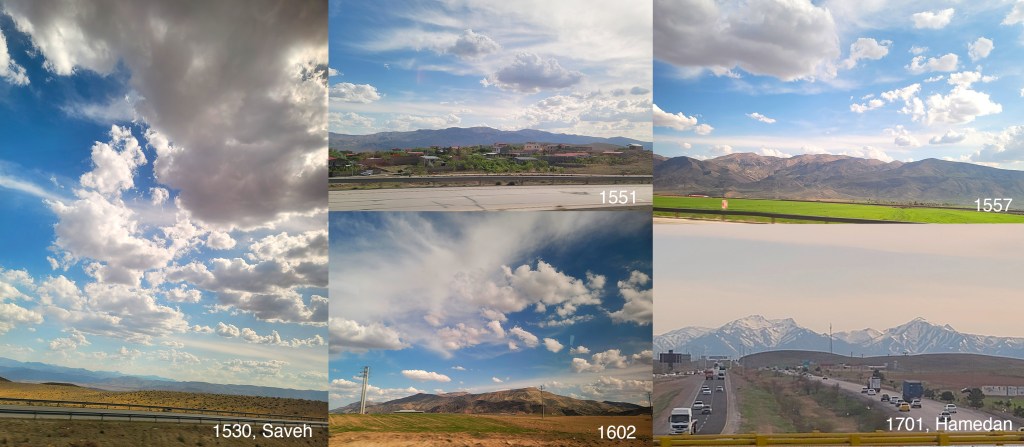
I tried to write on the bus, but I was captivated by the changing landscape. Our route took us through the dark, dense greenery south of the Tochal mountains of the Alborz range, to the arid, rolling hills and vast skies dotted with thick cumulus clouds between Eslamshahr and Saveh, to the hardy foliage of the snow-capped Alvand highlands. Alvand is a cluster of mountains in Hamedan Province that forms the northeastern perimeter of the much larger Zagros mountain range.
Observation: Islamic Saints and Roads
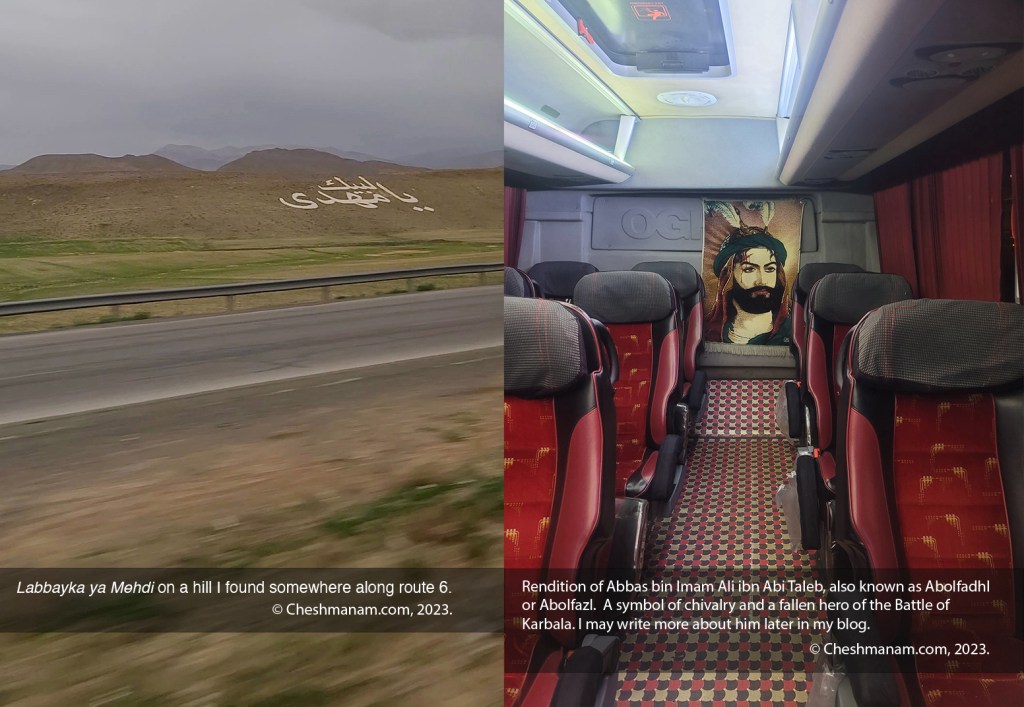
It was during the 3.5 hour journey to Hamedan that I realized that Islamic saints and Imams have a major presence and reverence on the highway, on cars, and especially on trucks. I saw “Labbayka ya Mehdi” as landscape art on a huge hill (“We are at your service, O Guided One”, which refers to the 12th Imam), and plenty of “Ya Abolfazl” inscribed mostly on the overhead compartments of trucks, referring to the saint, Abbas ibn Ali. “Lailahaillalah Muhammadan rasoolulah” or “Fatimatul Zahraa” and/or “Ya Ali Madad” bumper stickers on the rear window of cars — the former is extremely common in Saudi Arabia, but not the latter two. In fact, my own bus had a large tapestry hanging in the back, with an image representation/reminder of Abolfadhl (see footnote below).
Arrival to Hamedan and First Impressions:
The sky became more beautiful the closer we got to Hamedan. The ride took 3 hours and a half, and cost me 1,530,000 IRR (2.53 USD), with luxurious reclinable chairs, contoured perfectly for back support, and leg rests that raise the feet up. Reclining all the way down does not disturb the passenger behind you. Water and a bit of food are offered to passengers for free. 10/10.
I disembarked, and noticed the temperature felt significantly colder than in Tehran. My friend met me to guide me to my hostel.
But not without first introducing me to the Hamedan square and taking a nice long walk around the central part of the city. I don’t have any photos from that night. I was unimpressed with the city life, and I was cold and hungry (only had almonds and cherries so far). But being in a different environment and out of Tehran excited me enough to keep me going. I noticed that there were no cars on the road, and kiosks overtook the pavement. The square was lit up with bright lights. There were lots of those little carousel rides for toddlers. Eventually, we did find something to eat and went to my hostel.
I met the host, and he spoke with my friend for a bit. I was placed in a little windowless room** (see footnote below), that was accessible from the Breakfast dining area. The door was made from stained coloured glass. It could not lock at the time, and the door was raised by 8 inches off the ground. I took my shoes off and entered the room — I had to climb up a giant step (the room was elevated). My host spoke excellent English and told me to take time to think about it, and he left. It seemed fine… I was thinking about how the shower shared the same ground as the rest of the washroom floor, without a barrier (a common feature in most Iranian washrooms). Not a fan of wet floors, even with washroom slippers, but I must adapt.
I was so cold that night. I made sure the space heater worked, and it covered the room with an orange glow, reminiscent of a fireplace. There were 2 working outlets in the room. This might sound like a bad review, but I genuinely loved the place as I love rustic places! The only issue was with the bed. I moved to a thin mattress on the floor and my spine was happier, so I could finally fall asleep.
P.S., I would return to this same hostel a month later — the hosts were incredible. My stay got better, and I’m glad I gave this hostel a chance. Another 10/10 rating.
Footnote:
*Images of Saints: Muslims usually believe icons or images are not permissible, particularly of important religious figures. However, this view varies in extremity, as some sects forbid the drawing of any living creature and often censor eyes out of all pictures, whilst others believe it is fine to draw eyes. In Iran, there is a wide variation of opinions: some are okay with representations of saints and/or Imams, though many feel that veneration of the saints should exclude visual representations of them, as Ithnaa’ ‘Asheri scholars usually discourage the practise. In re-enactments of Karbala, the people who represent the saints keep their faces covered. Did you know that literacy expanded under Islamic rule, as calligraphy became the preferred work of Art, rather than relying on portraits and illuminated manuscripts heavily used in Europe to aid illiterate worshippers in understanding the Bible.
** Windowless Rooms? I noticed this was common in a certain type of hostel in Iran: traditional (sonnati) hotels usually have a window into the courtyard or windows that open into a balcony, but more economical hostels (bomgardi) have windows on the doors—stained glass, usually, or clear and covered with a fabric—just enough to some light into the room during the day. I believe it is meant for privacy and to prevent the rooms from overheating.

 Iran, Az Cheshmanam