
{travel tips}
All it takes is a little media literacy to learn that it is specific media outlets that dramatise the reality of Iran’s national dress code. However, dress code there is, and it’s nothing to worry about and will not impede your enjoyment of your trip. I also cover a little bit about common behavioural practices in public spaces (i.e., code of conduct) and female travel safety.
DRESS CODE
{WOMEN}
No, you do not have to wear the long black cloak (chador) that you see in photographs. Many Iranian women do not wear chador outside of a mosque. The photo to the right shows me in a white chador, inside a holy shrine. Chadors must be worn in a religious setting (you will be given a clean one upon entry to a mosque).
Tops must not be form-fitting. Length should ideally be a little below the hips, and sleeves should be past the forearm. No low-cut tops.
Pants must not be form-fitting (unless you have on a longer top). Length must be at ankle. Long skirts are also an option.
Head-covering or scarf: there are numerous styles of scarves and different methods of wearing the headscarf. All styles are fine. It’s fine if some of your hair shows, but as always, know your environment. In mosques or when visiting conservative friends, keep it on properly.
During the summer, do not wear polyester headscarf or hijab. Opt for natural fabrics and it will protect you from the sun and heat.
Noteworthy: in more liberal cities like Shiraz, Tehran, or Rasht, you might notice that women dress more liberally. Sometimes very liberally. However, as a guest in any country, you better abide by the social customs and national laws.
{MEN}
Men have a more flexible dress code. Just note that wearing shorts, especially knee-length or above, is not common. If you wear shorts and try to enter some museums, the bank, or the masjid, you will be asked by guards to return later wearing longer pants. Also, nothing too tight, and no obscene graphics on t-shirts.
______________________________________________________________________________
{Guidance Patrol or Morality Police}
As an Arab woman who can pass as a local Iranian, I have been corrected twice by “guidance patrol”, but it is not the big scary scene that western media portrays it to be.
Typically in mosques, the university, or by the subway, there are female volunteers who sit by the entrance–exits at a table in a corner. They stand watch as crowds move in and out.
If you’re wearing something tight or revealing, they may call on you “Khanom! (Missus!)” or they may make a gesture to you to button your sweater or position your headscarf properly.
I say “may” because on numerous occasions, I’ve seen them ignore women who’ve removed their scarves. When it comes to Iran, do not believe the mainstream media outlets of the west that peddle anti-Iran propaganda.
Noteworthy:
If you’re ever in doubt about whether to dress conservative or more relaxed, just look around you. Vigilance is a useful skill for any traveller. Assess your surroundings, and get a sense of what social rules would be a stigma/taboo or okay. Every neighbourhood in every city has slightly different rules of what is accepted and what is not, in addition to location (embassy, Imamzadeh, hiking, the mall, etc.). Your tour guide will know, and communicate with you when you need to dress more conservatively and when you can loosen up more. All these can be asked to your local friends or to a guide.
Female Traveller Safety
As a woman who has confidently travelled around Iran alone in 2023, 2024, and 2025, I can attest to Iran being SAFE for female travellers.
In fact, I feel safer walking alone at night in Isfahan than walking down the sidewalk mid-day in Seattle, Cairo, Egypt or Athens, Greece.
Don’t just take my word for it. Here are just a few of the recent solo female travellers who have positive things to say: Syifa Adriana, Eva Zu Beck, Krikkos Adventure, Zoe Languages, and more (there are plenty more, as well as solo male travellers, but I’m only sharing those with detailed videos and popular platforms). Special mention to Geenyada, another solo female traveller, but to Afghanistan!
Code of Conduct
{Shaking Hands} To greet someone of the opposite gender, you say “Salam” or another equivalent greeting, like Shab bekhayr (“good evening”), whilst putting your right hand on your heart. Most conservative men will not shake hands with women — if you’re not sure, just err on the side of caution and do the hand-on-heart greeting.
{PDA: Public Displays of Affection} From the above rule, you can infer that PDA in public is definitely not recommended, even if you’re married. There are levels to this, though — just use your judgement and be appropriate for the type of environment you’re in (any traveller should learn this skill). You can always hold hands in public.
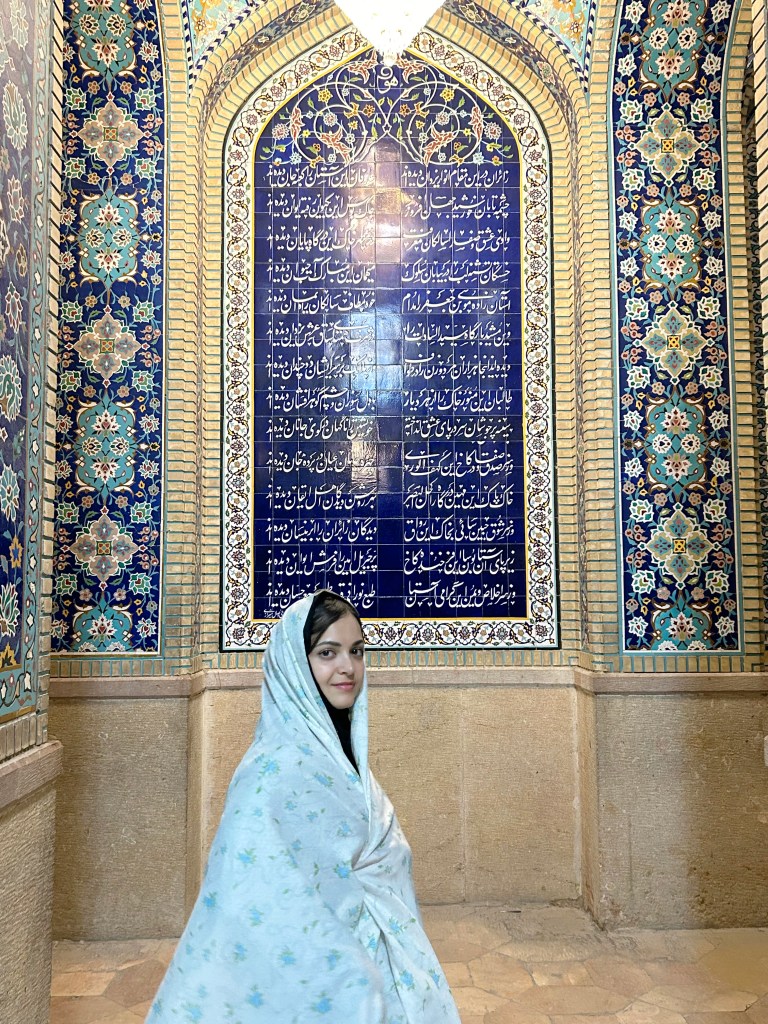
Attendants at the Shah Cheragh holy shrine in Shiraz pass a clean chador for any woman to drape over themselves until they leave. Chador is literally “tent”. I was wearing an outfit modest enough for Iran, but not enough for the holy grounds. You can bring your own chador to holy spots, or the volunteers can temporarily provide you with one.
 Iran, Az Cheshmanam